


SUZHOU BESTAR BLOW MOLDING MACHINERY Co., Ltd, located in Zhangjiagang city, Jiangsu Province, is a notable member of the BEIER MACHINERY GROUP. Established in 1998, BEIER MACHINERY GROUP has grown into one of China's largest plastic machinery manufacturers. Their operations span over 120,000 square meters and employ more than 400 staff members.
Product Range
BESTAR's blow molding machines are designed to produce HDPE and PP articles, which are essential for various applications such as: food and beverage packaging, daily chemical products packaging, chemical stacking barrels, and automobile engine oil packaging. The machines can handle volumes ranging from 20ml to 30L, catering to diverse production needs.
Advanced Technology
BESTAR's blow molding machines use advanced MC-ML (multiple cavities multiple layers) technology, known for its efficiency and cost-effectiveness. This state-of-the-art technology helps to reduce each article′s production cost without compromising article′s quality or appearance.
Professional Installation
BESTAR offers comprehensive installation services through a trained team with extensive experience. The team is equipped with the necessary skills and tools to ensure efficient and reliable installation.
Quick Response
To minimize downtime, BESTAR has local professional service technicians positioned across the country. They aim to arrive on-site within 2 hours to provide prompt and effective maintenance solutions.
Accessories Supply
BESTAR maintains a large inventory of high-quality, original accessories and kits. All accessories are subjected to strict factory testing to ensure they meet specifications and support continual, trouble-free operation.
Leading Service
We have many years of industry experience, a complete production management, quality supervision, and sales service operation system. Whether you want to purchase Food Beverage Blow Molding Machine or Daily Chemical Blow Molding Machine, just email your requirements and we can customize the product for you.

Lubricant Oil Bottle Blow Moulding Machine
A Lubricant Oil Bottle Blow Molding Machine is a specialized piece of equipment used to produce a variety of hollow plastic containers, such as lubricating oil bottles, engine oil bottles, and motor oil bottles. These machines offer several advantages, including low investment, high efficiency, quick and safe operation, and ease of troubleshooting and maintenance.

Milk Bottle Blow Moulding Machine
Milk bottles are produced by milk bottle blow molding machines, which are small, continuous-type extrusion machines. In these machines, an extruder continuously produces a parison. This parison is then captured in a mold. Once the mold closes, air is injected through the top or neck of the parison, causing the hot plastic material to expand and touch the walls of the mold.

Food Bottle Blow Moulding Machine
A Food Bottle Blow Moulding Machine is a piece of automated high-speed equipment that produces plastic bottles of different shapes and sizes with high-pressure compressed gas. With this machine, a plastic bottle manufacturer can be able to produce a wide broad range of finished plastic bottle products in varying sizes and shapes.

Shampoo Bottle Bottle Blow Moulding Machine
In the realm of packaging solutions, shampoo bottle blow molding machines are indispensable tools for crafting the containers that house hair care products. These machines are engineered to produce high-quality bottles that excel in both durability and aesthetic appeal. A standard type of these machines is the extrusion blow molding machine, which features a double-station tie bar structure. The clamping system uses a three or four tie bar direct locking structure with an automatic lubrication system. This design is simple, stable, and facilitates convenient collection of plastic waste.
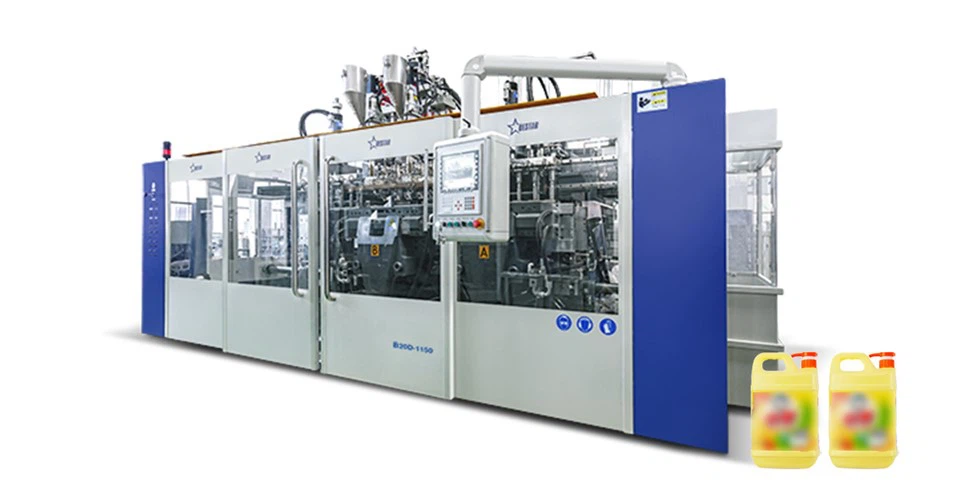
Detergent Bottle Bottle Blow Moulding MachineA Detergent Bottle Bottle Blow Moulding Machine is a device that uses compressed air or hydraulic pressure to blow molten plastic into a mold cavity to form a finished product. Its advanced technology ensures that every detergent bottle produced is of consistent quality, meeting the stringent standards of the industry.

Medicine Bottle Blow Moulding Machine
A Medicine Bottle Blow Moulding Machine is mainly used in the pharmaceutical plastic packaging industry. Blow molding process by heating plastic particles into a liquid form, the liquid form of raw materials into the mold cavity, and it will form a plastic bottle by blowing air into the mold cavity.
What is Jerry Can Blow Moulding Machine
Jerry Can Blow Moulding Machines are designed to shape durable containers for storing liquids. These machines efficiently mold HDPE plastic into jerrycan shapes, ensuring the production of leak-resistant and high-quality containers. They are ideal for industries that require reliable liquid storage solutions.
Advantages of Jerry Can Blow Moulding Machine
Cost-Effectiveness
Jerry Can Blow Moulding Machine is a highly efficient and cost-effective production method, particularly for large-scale manufacturing. It allows for the production of hollow parts, reducing material usage and overall costs.
Design Flexibility
Jerry Can Blow Moulding Machine enables the production of complex shapes and designs, including intricate contours, handles, and indentations. It offers excellent design flexibility, making it suitable for a wide range of products.
Seamless Construction
Jerry Can Blow Moulding Machine creates seamless parts, eliminating the need for additional assembly or joining processes. This seamless construction enhances the structural integrity and durability of the finished products.
Wide Range of Materials
Jerry Can Blow Moulding Machine supports various materials, including high-density polyethylene (HDPE), polypropylene (PP), and polyethylene terephthalate (PET). This versatility allows manufacturers to select the most suitable material for their specific application requirements.
Blow molding is a really direct and simple process that consolidates melting or liquefying, homogenizing, extruding, molding, cooling, and ejection. Below are the steps of the blow molding process of Jerry Can Blow Moulding Machine.
Plastic Resin Feeding or Charging
The most important and essential step in the blow molding process is plastic feeding. This is done by conveying the plastic pellets into the extruder container. Vacuum pumps draw pellets from enormous bags or mass containers and further transfer them into unrefined substances silos or hoppers. A rotatory feeder at the lower portion of the silos controls the rate or pace of feeding into the plastifier or extruder. To carry the stored pellets to the extruder hopper compressed air is used in the process.
Plasticizing or Melting
As the plastic resin enters and goes through the extrusion machine, it is melted or softened by persistent kneading and heating. Electric heating components or heating bands are wrapped around the If we talk about extruder barrel few electric heating components are wrapped around it so that proper heat or intensity is provided for melting the polymer. The extruder screw has various sections that serve a particular purpose. These are taking care of, feeding, compressing, and metering. The extruder screw is designed to provide adequate shearing and compression to homogenize and extrude the plastic.
Parison Extrusion or Preform Injection
In this process, it is about the preparation of the parison or preform to be inflated or expanded. This is done by extruding the plastic through free extrusion or injection into a preform mold or shape.
Sealing or Clamping
Sealing or clamping includes a split die that captures or catches the preform. The closures of the parison are sealed or fixed aside from one hole, regularly the container opening, where the compressed air will be injected or infused.
Inflation or Blow Molding
This step is where the plastic takes its form or structure. Compressed air is introduced inside the preform. This blows up the preform until it is molded or shaped by the profile of the die.
Cooling and Ejecting
The subsequent stage is the cooling process. Ordinarily, as the plastic touches the die, it cools at a predefined rate which settles the dimensions of the product. In the wake of cooling, the mold opens and ejects the product.
Trimming
Auto de-flashing such as the dies clamp the preform are features you will find in most blow molding machines. In any case, on specific occasions, a flash is available at the top and base parts of the product, especially at the opening where compressed air is injected or infused. This excess material is trimmed by a pivoting knife. To limit wastage, a few systems gather the excess materials, grind them, and feed them back to the extrusion machine.
Leak Test
This is the run-of-the-mill quality control technique utilized in manufacturing bottles or packaging materials. The machine will then check in the event that air enters or escapes the container by monitoring the pressure. In the event that a leak is detected from the container, it is rejected and taken care of once more into the system.
Materials Used in Jerry Can Blow Molding Machine
Blow molding refers to a molding procedure that the production industry employs to manufacture hollow objects composed of plastic. Selecting the appropriate plastic material for any blow molding process can be challenging. Strength, flexibility, density, cost, and more factors help decide which plastic material is suitable for blow molding. Here is an outline of the drawbacks, benefits, and characteristics of plastic materials used in blow molding.
High-Density Polyethylene (HDPE)
High-density Polyethylene is the most frequently blow-molded plastic resin. This is because of its desirable physical qualities, high strength-to-density ratio, temperature resistance, and chemical resistance. High-density Polyethylene is employed in an extensive range of products, including consumer liquid bottles such as motor oil and shampoo, industrial drums, carrying cases, play structures, and coolers. It is molder-friendly, easily colored, chemically inert, and easily colored. The Food and Drug Administration has approved high-density Polyethylene.
Low-Density Polyethylene
Versions of low-density Polyethylene encompass ethyl-vinyl-acetate and linear-low. Manufacturers employ low-density Polyethylene for softer items that require a high degree of flexibility or stress crack resistance. Usually, the higher the ethyl-vinyl-acetate content, the weaker the molded component is. Typical applications of low-density Polyethylene encompass boat fenders, traffic channelizers, and squeeze bottles. Low-density Polyethylene is also easily colored, translucent, chemically inert, and mold-friendly.
Polypropylene
Polypropylene is a very famous injection molding material. Polypropylene is like high-density Polyethylene, but its slightly lower and stiffer density benefits. Manufacturers commonly use polypropylene in elevated temperate uses like medical components and dishwater tubes that need autoclave sterilization. It is molder-friendly, quickly colored, and translucent.
Polyvinyl Chloride(PVC)
Even though polyvinyl chloride is the third-ranked plastic of the world, Polyvinyl chloride has been intensely examined for utilizing lead and cadmium as stabilizers. It releases hydrochloric acids while processing and releases remaining vinyl chloride monomers following molding(most of these problems have been decreased). Polyvinyl chloride is translucent. It comes in soft and rigid forms- the soft material. Manufacturers usually use the soft version of polyvinyl chloride in blow molding. Typical use includes traffic cones, bellows, and delicate medical components.
Acrylonitrile Butadiene Styrene (ABS)
Acrylonitrile Butadiene Styrene is comparatively hard plastic. Blow molding standard Acrylonitrile Butadiene Styrene is usually colored for use and clear in small appliances and electronics housings. After drying, Acrylonitrile Butadiene Styrene molds well. Nevertheless, the chemical resistance of components composed of Acrylonitrile Butadiene Styrene is not like the chemical resistance of polypropylene. Therefore caution should be employed in using this plastic with ingredients exposed to chemicals.
Polyamides/Nylon(PA)
Nylon melts rapidly; therefore, manufacturers commonly utilize it in injection molding. The materials employed for extrusion blow molding are usually versions of nylon four to six, nylon six to six, nylon eleven, and nylon six. Nylon is an affordably priced translucent material that poses decent resistance to chemicals and gives a good performance in highly heated environments.
Co-Polyester and Polyester
Unlike Polyethylene Terephthalate, manufacturers can do extrusion blow molding of modified polyesters such as co-polyester and Polyethylene Terephthalate glycol. Sometimes, co-polyester is employed to replace polycarbonate inside container products. It is like polycarbonate, but it is not that strict or precise, and it does not comprise bisphenol A, a substance that, according to some research, causes health problems.
Polyurethane and Urethane
Urethanes have performance qualities that are popular in coverings such as paint. Generally, urethane's elasticity is greater than polyurethane's, which needs to be formulated especially for becoming thermoplastic urethane. The thermoplastic standards can be injection or extrusion and cast blow molded. This is most frequently utilized as a single layer in multiple-layer blow molding.
Thermoplastic Elastomers
Manufacturers use thermoplastic elastomers to replace natural rubber inside molded components. This material is explicit and can be colored (usually black). After drying, it molds and usually reprocesses well.

How to Choose a Jerry Can Blow Molding Machine
Capacity Requirements
Determine the required capacity per hour based on your production needs. Different models of blow molding machines have different production capacities and need to be selected according to actual needs.
Molding Size and Shape
The size and shape of the jerry can will affect the choice of Jerry Can Blow Molding Machine. Make sure your blow molding machine can produce jerry cans that meet your specifications.
After-Sales Service and Support
Choose a supplier with reliable after-sales service and support to ensure that the Jerry Can Blow Molding Machine is maintained and maintained.
Material Adaptability
Make sure the Jerry Can Blow Molding Machine can handle the plastic raw material you are using, such as polyethylene (HDPE) or polypropylene (PP), etc.
Degree of Automation
The degree of automation affects production efficiency and costs. Jerry Can Blow Molding Machines with a high degree of automation may be more suitable for mass production.
Quality and Stability
Choose a Jerry Can Blow Molding Machine brand and model that has a good reputation, reliable quality and high stability.
Energy Consumption
Consider the energy consumption of the Jerry Can Blow Molding Machine and choose a model that can save energy costs.


