

Hey there! I'm a supplier of Detergent Bottle Bottle Blow Moulding Machines. Today, I wanna chat about how to adjust the temperature distribution in these machines. It's a crucial aspect that can greatly impact the quality of the detergent bottles we produce.
First off, let's understand why temperature distribution matters. In the blow - moulding process, the plastic material needs to be at the right temperature at different parts of the mould. If the temperature is too high in some areas, the plastic might become too soft and cause the bottle to have thin walls or even deform. On the other hand, if the temperature is too low, the plastic won't flow properly, leading to uneven thickness and potential defects in the final product.
One of the key things to consider is the heating system of the Detergent Bottle Bottle Blow Moulding Machine. Most machines use electric heaters or infrared heaters. Electric heaters are quite common as they're relatively easy to control. You can adjust the power output to change the heating rate. For example, if you notice that the bottom part of the mould is getting cooler than the top, you can increase the power to the heaters near the bottom.
Infrared heaters, on the other hand, offer more targeted heating. They can heat specific areas of the plastic pre - form more precisely. You can position these heaters strategically around the mould to achieve a more even temperature distribution. If you're using a machine with infrared heaters, make sure to check their alignment regularly. Over time, they might shift slightly, which can affect the heating pattern.
Another important factor is the cooling system. After the plastic is blown into the mould, it needs to cool down quickly to take the shape of the bottle. But the cooling process also needs to be well - controlled. If the cooling is too fast in some areas, it can cause internal stresses in the bottle, making it more prone to cracking. A good way to manage the cooling is by using a water - based cooling system. You can adjust the flow rate of the water to control the cooling speed. For instance, if the neck area of the bottle is cooling too slowly compared to the body, you can increase the water flow around the neck.
Now, let's talk about the pre - heating of the plastic pre - forms. Before they are blown into the mould, the pre - forms should have a uniform temperature. This can be achieved by using a pre - heating oven. You can set the temperature and the time of pre - heating according to the type of plastic you're using. Different plastics have different melting points and heat - transfer properties. For example, PET (polyethylene terephthalate), which is commonly used for detergent bottles, requires a specific pre - heating temperature range to ensure good blow - moulding results.
Monitoring is also a big part of adjusting the temperature distribution. Most modern Detergent Bottle Bottle Blow Moulding Machines come with temperature sensors. These sensors can provide real - time data on the temperature at different points in the mould and the pre - form. You can use this data to make immediate adjustments. For example, if the sensor shows that the temperature at a certain spot in the mould is 10 degrees higher than the desired temperature, you can reduce the power to the corresponding heater.
It's also worth mentioning that the design of the mould itself can affect the temperature distribution. A well - designed mould will have proper channels for heating and cooling fluids. These channels should be evenly distributed around the mould to ensure uniform heat transfer. If you're having trouble with temperature distribution, it might be a good idea to check the mould design and see if there are any areas that could be improved.
Let's take a look at some specific types of blow - moulding machines in our product line. The Inclined Neck Toilet Bottle Blow Moulding Machine has its own unique requirements for temperature distribution. The inclined neck design means that the plastic needs to flow in a different way compared to a regular straight - neck bottle. You might need to adjust the heating and cooling settings more carefully to ensure that the neck area gets the right amount of heat and cools evenly.
The Laundry Detergent Bottle Blow Moulding Machine is also another important product. Laundry detergent bottles often have different shapes and sizes, and this can impact the temperature distribution. For larger bottles, you might need to increase the heating time and power to ensure that the plastic in the middle of the pre - form gets heated properly.
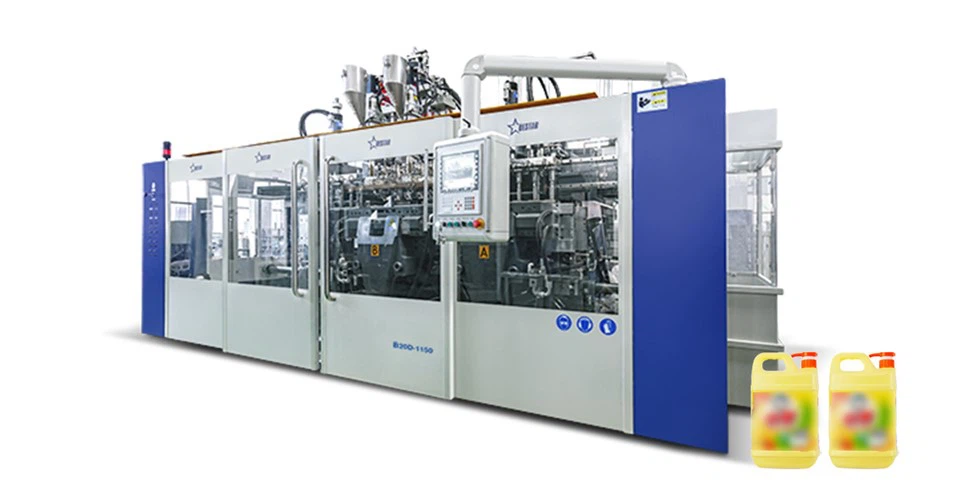

In conclusion, adjusting the temperature distribution in a Detergent Bottle Bottle Blow Moulding Machine is a multi - faceted process. It involves managing the heating and cooling systems, pre - heating the plastic pre - forms correctly, monitoring the temperature, and considering the mould design. By paying attention to these aspects, you can produce high - quality detergent bottles with consistent thickness and good overall quality.
If you're in the market for a Detergent Bottle Bottle Blow Moulding Machine or need more advice on temperature adjustment, don't hesitate to reach out. We're here to help you get the best results from your blow - moulding operations.
References
- Blow Molding Handbook by Rosato, David V.
- Plastics Processing by Osswald, Tim A.